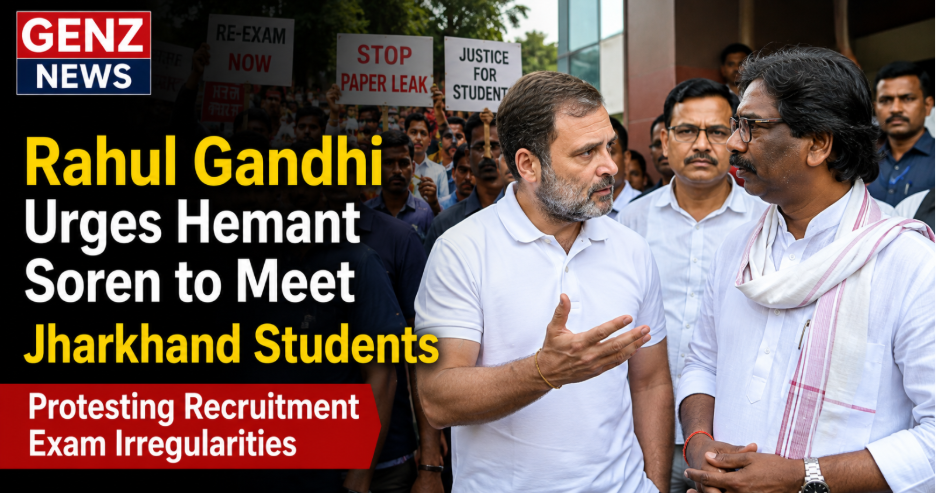
Congress leader and Leader of Opposition in the Lok Sabha, Rahul Gandhi, has written to Jharkhand Chief Minister Hemant Soren, urging him to personally meet the students who have been protesting for over three weeks against alleged irregularities in the state’s recruitment examinations. The intervention comes as the agitation in Ranchi enters its 24th day, keeping the spotlight on education and recruitment accountability once again.
What Rahul Gandhi’s Letter Says
In a letter dated August 14, Gandhi described the ongoing protest as peaceful and said the students’ demands were legitimate. He acknowledged that the Jharkhand government had already opened a dialogue with the protesters through a committee set up by Soren himself, and noted that there appeared to be agreement on several of the demands raised so far.
However, Gandhi pointed out that despite this progress, the agitation has continued, with some students remaining on an indefinite hunger strike. It was in this context that he suggested a more direct step: a personal meeting between the Chief Minister and student representatives, which he said would help reinforce the government’s commitment to resolving the remaining issues.
“The youth of India is its future. We owe them our solidarity and support at this moment of crisis,” Gandhi wrote, appealing to Soren to hear the protesters out and act on their concerns.
The Root of the Protest: JPSC and JSSC Exam Irregularities
The demonstration at Ranchi’s Jaipal Singh Munda Stadium has been running since late July, with candidates demanding a thorough investigation into alleged irregularities in the 14th Jharkhand Public Service Commission (JPSC) Civil Services Examination and the Jharkhand Staff Selection Commission Combined Graduate Level (JSSC-CGL) exam, among other recruitment tests.
Following sustained pressure, the state government proposed cancelling three examinations, including the preliminary round of the 14th JPSC Civil Services exam. However, protesters have continued to press for the JSSC-CGL exam to be scrapped as well — a demand the government has so far declined to accept, which is part of why the agitation has dragged on even after some concessions were made.
This pattern of exam-related unrest is not unique to Jharkhand; similar recruitment and paper-leak controversies have flared up in other states in recent years, reflecting a wider concern among India’s youth over the transparency of competitive exams, a topic frequently covered in our news section.
A Political Balancing Act
The appeal carries an added layer of political nuance because the Congress is itself a coalition partner in the ruling Jharkhand alliance, led by Soren’s Jharkhand Mukti Morcha (JMM) along with the Rashtriya Janata Dal and the CPI(ML) Liberation. Gandhi’s letter, therefore, is not opposition pressure in the conventional sense — it’s an ally publicly nudging its own coalition government to act more decisively.
In the same letter, Gandhi also took aim at the BJP and the RSS more broadly, alleging that India’s education system had been “captured” by these organisations and turned into a tool that exploits and oppresses students rather than empowering them. He argued this had eroded the country’s education framework compared to what it was a decade ago — a charge that ties into ongoing debates within state politics over who bears responsibility for recruitment failures.
Ground Situation Remains Tense
While Gandhi’s letter framed the protest as peaceful, on-ground reports suggest the situation has grown increasingly strained. Heavy police deployment, barricading, and the use of crowd-control measures have reportedly been used against demonstrators at points during the agitation, and there have been restrictions affecting journalists covering the protest as well.
Adding to the tension, some protesters reportedly burnt effigies of both Soren and Gandhi at one stage, reflecting growing frustration among a section of the agitators over demands that remain unmet despite weeks of talks. This underscores that even with dialogue underway, trust between the protesters and the government remains fragile — a dynamic worth watching as the story develops, alongside broader coverage in Jharkhand and neighbouring states.
Why This Matters
Rahul Gandhi’s appeal puts renewed focus on how India’s states handle recruitment-exam controversies, a recurring flashpoint that has triggered youth protests from Bihar to Jharkhand in recent years. For the JMM-Congress alliance in Jharkhand, the optics of a coalition partner publicly urging the Chief Minister to act carry real political weight, especially with a hunger strike still ongoing and public patience wearing thin.
Whether Soren responds with the personal meeting Gandhi has requested — and whether that meeting resolves the standoff over the JSSC-CGL exam — will likely shape how this protest is remembered: either as a case of coalition politics working to correct course, or as another instance where dialogue alone wasn’t enough to end a student agitation. Readers can follow further developments through our ongoing political and education coverage.