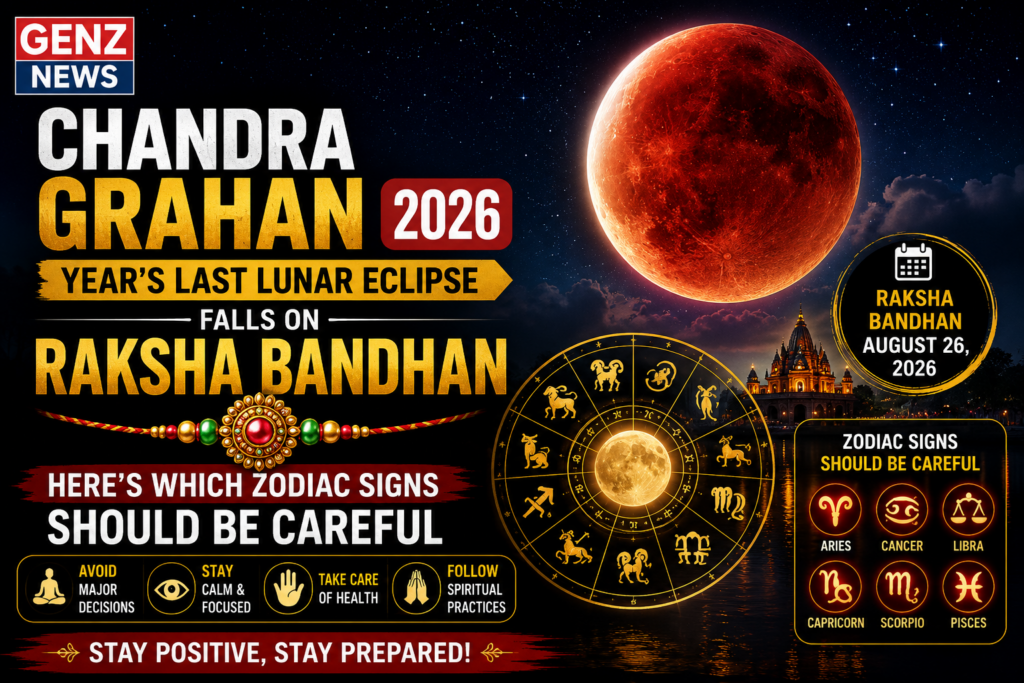
Just as families across India get ready to celebrate Raksha Bandhan, the skies are lining up for something astrologically significant. The year’s last lunar eclipse, or Chandra Grahan, is set to occur on August 28, 2026 — the very same day as the festival — and according to astrologers, its placement this time makes it an unusually sensitive one. If you’re someone who keeps an eye on planetary movements alongside everyday news, this is one eclipse worth understanding properly.
When and Where This Eclipse Will Occur
This will be a partial lunar eclipse, beginning around 6:53 am and continuing until roughly 12:31 pm. According to astrological calculations, it will take place in Kumbh Rashi (Aquarius) under Shatabhisha Nakshatra — a placement that carries extra weight because Kumbh is ruled by Shani (Saturn), while Rahu is also considered a fierce rival of the Moon. Timing details like these are the kind of thing families often plan their Raksha Bandhan rituals around, a festival we also cover in our lifestyle section every year.
Here’s an important practical detail, though: this eclipse won’t be visible in India. Because of that, the traditional Sutak Kaal period and its associated rules and restrictions won’t apply for those observing it from within the country. Temples will stay open, and daily routines can continue as normal, even though the astrological effects are still expected to be felt on a subtler level — a nuance that often gets buried in broader news coverage of eclipse events.
Why This Particular Eclipse Is Considered So Sensitive
In Vedic astrology, the Moon governs the mind, emotions, mental peace, and overall sense of stability. When Rahu casts its shadow on the Moon, it’s said to stir up confusion, restlessness, and a kind of mental fog that makes clear decision-making harder than usual. This time, the situation is considered doubly challenging because the Moon will be sitting in Shani’s own sign of Kumbh while also placed in Rahu’s Shatabhisha Nakshatra — meaning the Moon is essentially surrounded by two of its most difficult planetary relationships at once. Readers who follow our regular astrology and spirituality coverage will recognise this Shani-Rahu combination as one astrologers flag often.
According to mythological belief, Rahu and Ketu are said to attempt to “swallow” the Moon during a lunar eclipse, a story rooted in old cosmic rivalry, which is part of why eclipses have traditionally been viewed as periods of heightened negative energy in Indian astrology and culture.
Which Zodiac Signs Need to Be Careful
Astrologers tracking this eclipse have flagged a handful of zodiac signs likely to feel its effects more strongly than others. Kark Rashi (Cancer) and Singh Rashi (Leo) come up most consistently across astrological readings, given the Moon is Cancer’s own ruling planet and Leo sits in a challenging position relative to this eclipse’s placement. Vrishchik (Scorpio) and Meen (Pisces) are also frequently mentioned, with some astrologers extending the caution list to include Tula (Libra) and Kumbh (Aquarius) itself, given the eclipse falls directly in that sign — the kind of detailed sign-by-sign breakdown regular readers of our rashifal updates will be familiar with.
For these signs, the concerns astrologers are highlighting broadly fall into three buckets: health-related stress, financial strain or unexpected expenses, and friction in career or personal relationships. Those under Kumbh’s influence, for instance, are advised to be extra mindful of mental clarity, since the Rahu-Moon conjunction directly in their own sign could bring bouts of confusion or indecisiveness, particularly around matters of love, children, or education. Meen Rashi natives, meanwhile, are cautioned about rising workplace pressure and a heavier sense of responsibility during this period, given Shani’s placement affecting their sign — concerns that often overlap with broader career and personal finance worries people track separately.
A Word of Caution Before Starting New Ventures
One recurring piece of advice across astrological readings is to avoid initiating major new projects, signing important agreements, or starting fresh ventures during the eclipse window itself. This is a fairly standard precaution tied to eclipse periods in Vedic tradition, based on the belief that the disrupted planetary energy isn’t conducive to new beginnings. Instead, astrologers generally recommend using this time for reflection, patience, and staying grounded rather than pushing forward with big decisions — guidance that pairs well with the kind of practical planning tips found in our personal finance coverage too.
Keeping Perspective
It’s worth remembering that astrological interpretations like these are rooted in traditional belief systems rather than scientific consensus, and readers should approach them as one lens among many rather than absolute predictions. That said, for millions who follow these traditions, eclipse periods remain culturally significant moments, often marked by prayer, caution, and reflection rather than panic — a theme that resurfaces every festival season across our entertainment and culture coverage as well.
As August 28 approaches, more detailed sign-by-sign predictions and remedies are likely to surface from various astrologers, and we’ll continue tracking updates on this story as it develops, alongside our regular lifestyle and festival coverage tied to Raksha Bandhan celebrations this year.