
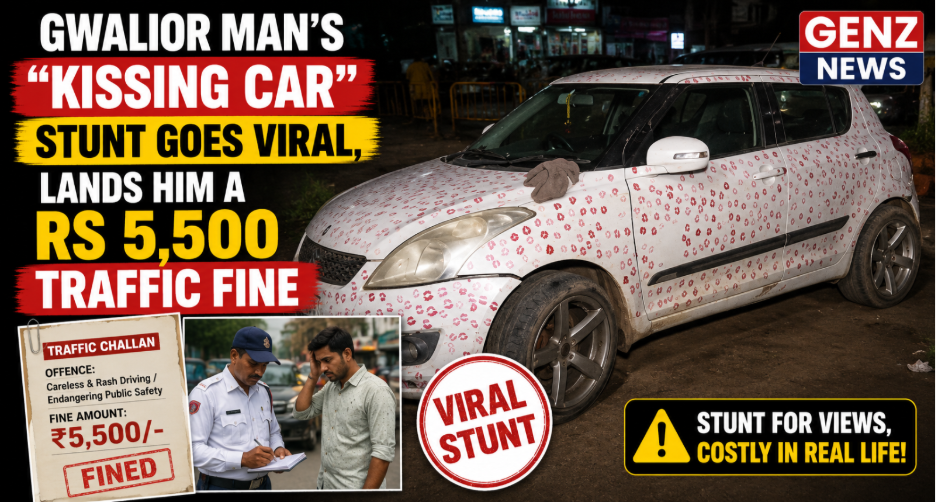
Sometimes love makes people do strange things, and sometimes those strange things end with a visit to the local traffic police station. That’s exactly what happened to Aditya Sikarwar, a young man from Gwalior, whose girlfriend covered his car in roughly 3,400 lipstick kiss marks for an Instagram reel — a stunt that racked up over 55 lakh views within a day, but also caught the attention of Gwalior Traffic Police, who ended up fining him Rs 5,500 and ordering him to scrub every last mark off. It’s the kind of only-in-India story that regularly turns up in our Madhya Pradesh coverage, and reminds you just how quickly a harmless social media idea can spiral into an expensive lesson.
How the “Kissing Car” Came to Be
According to Aditya, the whole idea started as an attempt to follow a trend he’d seen online — his girlfriend had come across what he described as a “foreign trend” and decided to recreate it on his car. She spent close to three and a half hours meticulously covering nearly the entire vehicle, including the bonnet and doors, in deep red lipstick kiss marks. Once the transformation was complete, Aditya took the car out for a spin, filming himself driving at fairly high speed, and later uploaded the footage to Instagram under the caption “kissing car.”
The reel took off almost immediately. Within 24 hours, it had crossed 5.5 million views, turning Aditya’s car into an unlikely social media sensation across the platform — the kind of viral moment that regularly gets picked apart across OTT and social media circles before authorities even get involved.
How the Police Caught Up With Him
Viral fame, it turns out, comes with its own risks. As the video spread, it eventually reached Gwalior Traffic Police, who noticed the car’s registration number — MP07 CC 9452 — clearly visible in the footage, since Aditya had been driving on public roads with the lipstick marks fully intact. Using that number, police traced the vehicle and identified it as belonging to Sikarwar. A police team subsequently located and seized the car from the Thatipur area of the city, and Aditya was called in to the traffic police station to answer for the modification, a sequence of events that reads like something straight out of our crime desk’s regular reporting on how viral content increasingly triggers real police action.
Once there, he was fined Rs 5,500 and instructed to remove every trace of the lipstick from his car. Rather than sending it off to a professional car wash, Aditya reportedly cleaned the vehicle himself, right there on the police station premises, using nothing more than water to scrub the marks away.
Why This Actually Counts as a Traffic Violation
At first glance, decorating a car with lipstick might seem like a harmless prank rather than something that warrants police action. But under Indian traffic regulations, unauthorised modifications to a vehicle’s external appearance — including covering its body in a way that alters its registered, factory-standard look — can fall foul of presentation and modification norms, the same broad category of rules that also covers things like illegal tinted windows or unapproved paint jobs, topics that come up fairly often in our technology and auto coverage whenever vehicle-related regulations make news. Speaking to reporters afterward, Aditya admitted he genuinely hadn’t realised the stunt crossed into illegal territory. “Since I wasn’t aware that doing so was illegal, after the police action, I cleaned the entire car body to remove the lipstick marks and paid a fine of Rs 5,500,” he said, adding that people should be careful not to do anything that violates the law.
A Reminder About the Cost of Chasing Views
This isn’t the first time a viral stunt has landed someone in trouble with authorities, and it’s unlikely to be the last. The appeal of quick views and follower growth has pushed plenty of content creators toward increasingly unconventional ideas, and this incident is a fairly clean example of how something designed purely for social media attention can carry real-world consequences once it’s filmed on a public road. For readers who enjoy following viral trends and their sometimes unexpected fallout, stories like this one are a regular feature of our lifestyle and trending coverage.
For Aditya, the whole episode has likely ended with a valuable, if slightly embarrassing, lesson: a viral reel might earn views, but it can just as easily earn a challan. We’ll continue tracking similar viral traffic incidents and their outcomes through our regular trending coverage.
This report is compiled based on statements from car owner Aditya Sikarwar and coverage by PTI, India TV News, and multiple national media outlets.